
1. Atomic-scale optoelectronics in two-dimensional transition metal dichalcogenides (TMDs)
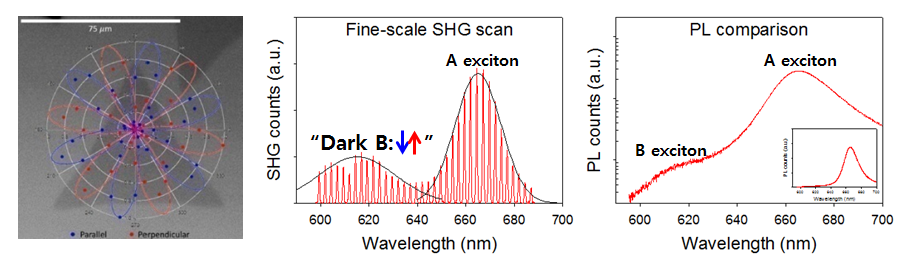
Figure 1. Nonlinear optical characterization of MoS2 monolayer.
Atomically thin monolayers of TMDs, MX2 (M = Mo, W and X = S, Se, Te), are emerging two-dimensional (2D) semiconductors that exhibit a number of intriguing phenomena for fundamental interest as well as potential electronic and photonic applications. Significant interest within optoelectronics lies in strong second-order optical nonlinearity, valley-selective circular dichroism, and tightly bound excitonic matter. While the monolayer system holds such a promising optical multi-functionality, its true potential has not been fully assessed from a fundamental point of view. More exotic many-body physics is also unmet in this truly unique 2D world.
The objective of the project is 1) to understand and manipulate fundamental light-matter interactions and 2) to utilize all the potential functionalities of the engineered MX2-based devices aiming at “coherent performance” at room temperature. The intellectual merit of the project basically lies in the distinctive nature of the MX2 monolayer arising from inversion symmetry breaking and strong many-body effects. The goal is directed toward exploiting these unique properties to advance the understanding of nonlinear optical and excitonic effects under resonant valley-selective optical excitation in general, but with a special emphasis on generating macroscopically coherent quantum states of exciton-polaritons under cavity confinement.
Highly
efficient nonlinear optical thin films could be useful for wavelength
conversion of ultrashort laser pulses and impact the laser industry as well as
military and medical applications when available as on-chip devices. Realization of room-temperature valleytronics
and excitonics will be a revolutionary step toward the new science and
technologies in the future. The proposed
scientific activities will considerably impact the development of entirely
2D-device architectures and ultrathin heterostructures especially when combined
with other 2D layered materials such as graphene, h-BN, black phosphorous, and
topological insulators.
2. Tuning
hybrid halide perovskites for photovoltaics and nonlinear optics
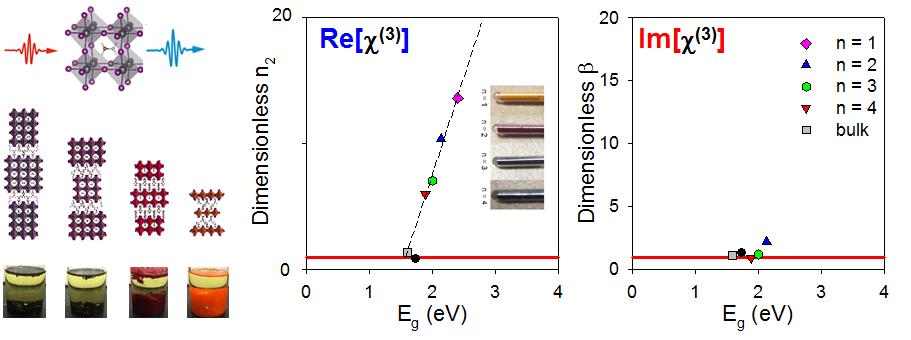
Figure 2: Selective enhancement of optical nonlinearity in 2D halide perovskite series.
Organic-inorganic halide perovskites, ABX3, (A+ = organic cation, B2+ = Sn2+ or Pb2+, and X– = halide anion) have outstanding potential for the next-generation photovoltaic (PV) technology due to the combination of useful hybrid properties such as high optical absorption, efficient charge transport, plasticity, and cost-effectiveness for fabrication. While the actual device architecture is a critical factor in terms of technology evolution, the basic understanding of essential light-matter interaction in these perovskite materials is unarguably important for furthering the power conversion efficiency as well as discovering other emerging optoelectronic properties such as thermoelectric, radiation detection, and nonlinear optical phenomena. Especially nonlinear optical effects in this class of materials in quasi-2D forms are relatively less explored but potentially important, and in fact they gained significant interest quite recently.
The objective of the project is 1) to study the impact of dimensionality (layer number) on the photophysical properties such as absolute optical absorption and time-resolved photoluminescence to correlate the actual PCE with the layer number and 2) to investigate high-order nonlinear optical effects such as third harmonic generation and multiphoton absorption. However, any “local ferroelectricity” will be also probed via second harmonic generation where the ferroelectric behavior can critically affect the PCE. These 2D hybrid semiconductors could be of great importance in nonlinear optics since the quantum confinement can often yield a large nonlinearity with the added advantage of environmental stability, when compared with the benchmark MAPbI3, which is the 3D bulk counterpart.
If the proposed concept is true, we can explore high-power/high-efficiency nonlinear optical materials prepared by cost-effective hybrid 2D framework where bandgap blueshift and enhanced nonlinearity can simultaneously contribute. The project will advance a general understanding of optical properties of hybrid halide perovskites. Clearly, basic knowledge generated from the project will serve as a foundation from which to develop future PV and nonlinear optical devices.
3.
Low-dimensional metal chalcogenides for nonlinear optical applications at infrared
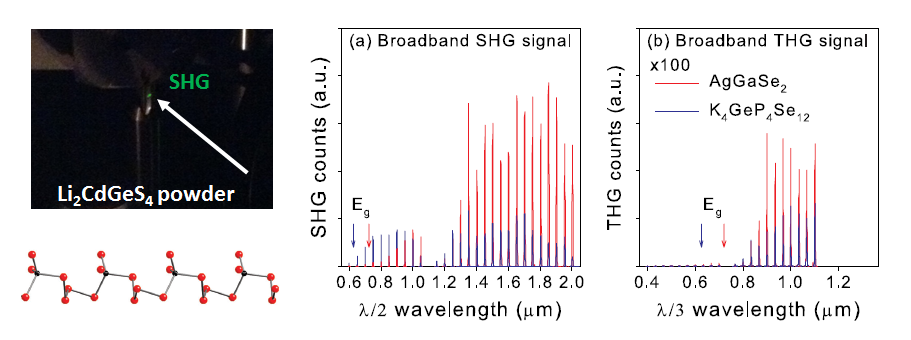
Figure 3: Wavelength-dependent harmonic generations in storngly nonlinear metal chalcogenides.
Nonlinear optical wave mixing using a high-performance noncentrosymmetric chalcogenide is especially promising for generating coherent light in mid-IR in terms of effectiveness and wavelength tunability. Currently, 3D chalcogenides such as AgGaSe2 and LiInSe2 are commercially available, which actually have dominated the market for decades. However, practical uses of these benchmark materials are severely limited by either an insufficient nonlinear susceptibility or a low laser-induced damage threshold (LIDT). Some researchers describe this as a “balance”, and targeting both a large nonlinearity and a high LIDT within a single material remains an outstanding problem. Nevertheless, next-generation IR nonlinear optical materials must overcome this mutual exclusiveness of the two key parameters in order to bring effective capabilities at difficult-to-reach IR ranges, i.e. the molecular fingerprint region.
The objective of the project is 1) to realize high-performance 1D nonlinear optical chalcogenides by fully exploiting the countercation effect and 2) to demonstrate that the engineered films and crystals from these chalcogenides exhibit excellent wavelength tunability over the very broad IR range. Specifically, we will target 1D chalcogenides showing the IR-generation efficiency more than 100 times higher than those of existing materials. We have been at the cutting edge of the development and characterization of novel nonlinear optical chalcogenides, generating numerous important publications (> 30), which build the basis of this project.
The project is highly specialized for efficient IR generation toward broader societal benefits. Emerging examples could include coherent IR laser sources, broadband IR telecommunication, remote sensing, minimal invasive medical surgery and diagnosis, and biological imaging and spectroscopy.